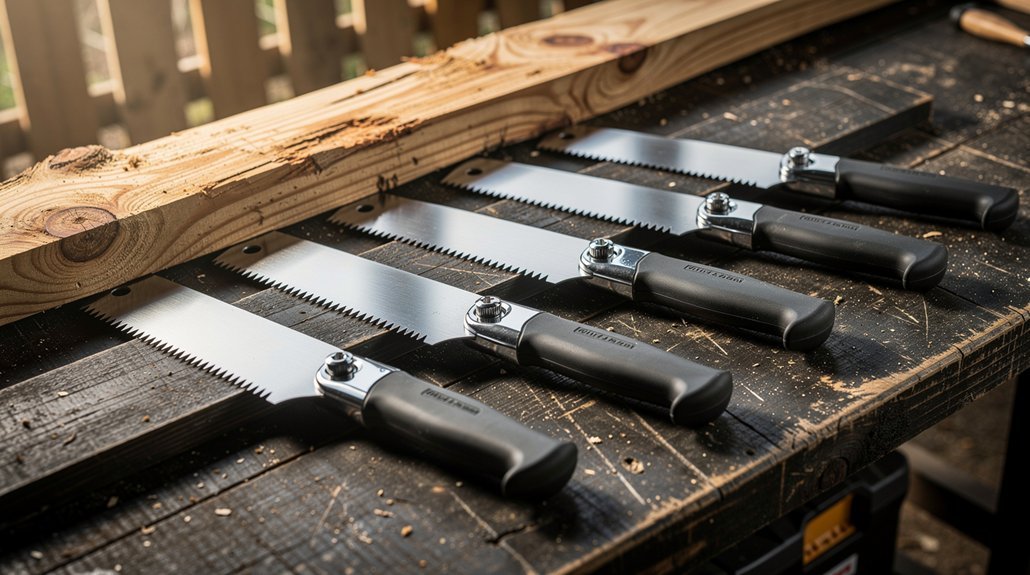
You’re about to compare the toughest hand saws on the market, each built to slice through rough‑sawn fence timber without bogging you down. From Japanese‑crafted blades to rugged folding steel, the models differ in tooth count, handle ergonomics, and rust‑proof coatings. Knowing which features matter most for your projects will let you pick the tool that stays sharp and balanced season after season. Let’s break down the specs and see which one earns the spot in your workshop.
| KAKURI 14″ Japanese Anahiki Timber Saw |  | Pro Pull Saw | Blade Length: 14 in | Blade Material: Japanese steel | Teeth Per Inch (TPI) / Tooth Count: 6.4 TPI (≈90 teeth) | CHECK ON AMAZON | Read Our Analysis |
| Bahco ProfCut 24″ Timber Saw with Rubber Grip |  | Heavy‑Duty Pro | Blade Length: 24 in | Blade Material: Steel | Teeth Per Inch (TPI) / Tooth Count: 74 teeth (≈3 TPI) | CHECK ON AMAZON | Read Our Analysis |
| IRWIN Hand Saw Coarse Cut ProTouch Handle 15-Inch (2011201) |  | Versatile All‑Purpose | Blade Length: 15 in | Blade Material: Steel | Teeth Per Inch (TPI) / Tooth Count: 14 teeth (≈0.9 TPI) | CHECK ON AMAZON | Read Our Analysis |
| 14″ Heavy Duty Hand Saw with Ergonomic Handle |  | Fast‑Cut Performer | Blade Length: 14 in | Blade Material: 65Mn steel | Teeth Per Inch (TPI) / Tooth Count: 11 TPI (≈? teeth) | CHECK ON AMAZON | Read Our Analysis |
| REXBETI 11″ Heavy-Duty Folding Saw (SK-5 Steel) |  | Compact Survival | Blade Length: 11 in | Blade Material: SK‑5 steel | Teeth Per Inch (TPI) / Tooth Count: 7 TPI (≈77 teeth) | CHECK ON AMAZON | Read Our Analysis |
More Details on Our Top Picks
KAKURI 14″ Japanese Anahiki Timber Saw
Looking for a hand saw that can slice through massive fence posts and thick branches without bogging down? The KAKURI 14″ Japanese Anahiki Timber Saw delivers exactly that. Its 14‑inch razor‑sharp Japanese steel blade, coated for rust resistance, tackles round or square timbers, beams, and logs with effortless pull strokes. We 8.5‑ounce, wooden handle wrapped in PP cane gives a secure, non‑slip grip, while the 90‑tooth, 6.4 TPI design maximizes speed on rough cuts. At 28.7 inches overall, it balances reach and control, making it a reliable, heavy‑duty choice for framing and outdoor timber work.
- Blade Length:14 in
- Blade Material:Japanese steel
- Teeth Per Inch (TPI) / Tooth Count:6.4 TPI (≈90 teeth)
- Handle Material:Wood with PP cane wrap
- Weight:8.5 oz
- Cutting Action (Pull vs. Push):Pull‑saw (pull motion)
- Additional Feature:Rust‑resistant blade coating
- Additional Feature:Pull‑only cutting motion
- Additional Feature:PP cane‑wrapped wooden handle
Bahco ProfCut 24″ Timber Saw with Rubber Grip
The Bahco ProfCut 24″ Timber Saw with Rubber Grip is the go‑to tool for anyone who needs to slice through rough‑sawn fence timber quickly and cleanly, whether you’re framing a garden shed or tackling outdoor construction. Its 24‑inch, fleam‑toothed blade cuts on push and pull strokes, and the non‑hardpoint teeth stay sharp longer. You can re‑sharpen it with File 272 and protect the teeth with the patented reusable plastic protector. The bi‑material, ergonomic handle reduces fatigue and boosts control during deep cuts. Built by Williams, the steel blade and thermoplastic elastomer handle deliver industrial durability, backed by a limited lifetime warranty.
- Blade Length:24 in
- Blade Material:Steel
- Teeth Per Inch (TPI) / Tooth Count:74 teeth (≈3 TPI)
- Handle Material:Thermoplastic elastomer (bi‑material)
- Weight:7.7 oz
- Cutting Action (Pull vs. Push):Push & pull (non‑hardpoint)
- Additional Feature:Re‑sharpenable with File 272
- Additional Feature:Patented reusable tooth protector
- Additional Feature:Bi‑material ergonomic handle
IRWIN Hand Saw Coarse Cut ProTouch Handle 15-Inch (2011201)
If you need a saw that tackles thick, rough‑sawn fence boards without slowing you down, the IRWIN 15‑inch Coarse‑Cut Hand Saw (model 2011201) delivers exactly that. Its 14‑tooth, M2‑engineered steel blade, thick‑body design, and deep gullets chew through wood quickly, while the tapered‑pitch nose keeps the cut stable. The ProTouch wooden handle feels comfortable and firm, reducing fatigue on long jobs. We’re lightweight at just a pound, making it easy to maneuver across or with the grain. Built for durability, it offers fast starts, reliable control, and lasting performance on demanding carpentry tasks.
- Blade Length:15 in
- Blade Material:Steel
- Teeth Per Inch (TPI) / Tooth Count:14 teeth (≈0.9 TPI)
- Handle Material:Wood (ProTouch)
- Weight:1 lb (≈16 oz)
- Cutting Action (Pull vs. Push):Push & pull (standard)
- Additional Feature:Tri‑Ground tooth geometry
- Additional Feature:Deep gullets for chip removal
- Additional Feature:Tapered‑pitch nose for clearance
14″ Heavy Duty Hand Saw with Ergonomic Handle
Who needs a saw that cuts faster while staying comfortable? You’ll love the heavy‑duty hand saw with its ergonomic anti‑slip TPR handle that fits any hand size and slashes fatigue. Its sharp triple‑ground teeth and 11 teeth‑per‑inch pitch deliver aggressive, fine cuts in push or pull strokes, boosting cutting speed up to 50 % over traditional saws. The 65Mn steel blade, 0.9 mm thick, resists rust and friction, lasting through repeated use on wood, PVC, laminates, and branches. This versatile, durable tool excels in gardening, DIY maintenance, and wood‑processing projects, making it a toolbox essential.
- Blade Length:14 in
- Blade Material:65Mn steel
- Teeth Per Inch (TPI) / Tooth Count:11 TPI (≈? teeth)
- Handle Material:TPR (anti‑slip)
- Weight:Not specified (lightweight)
- Cutting Action (Pull vs. Push):Push & pull (standard)
- Additional Feature:Triple‑ground teeth for fast cuts
- Additional Feature:Anti‑slip TPR ergonomic handle
- Additional Feature:Rust‑proof 65Mn steel blade
REXBETI 11″ Heavy-Duty Folding Saw (SK-5 Steel)
Looking for a rugged, compact saw that can tackle 6‑7‑inch branches while you’re clearing fence timber? The REXBETI 11‑inch Heavy‑Duty Folding Saw delivers exactly that. Its SK‑5 steel blade, staggered 7 TPI teeth, cuts through thick wood with ultra‑smooth precision. The rubber‑coated polymer handle stays firm in rain or heat, and the fold‑away design tucks the blade into a 4 × 2‑inch profile, weighing just 14.4 oz. You’ll appreciate the lifetime warranty and optional carry bag for camping, bushcraft, or yard work. This saw handles 6‑7‑inch diameters without fuss.
- Blade Length:11 in
- Blade Material:SK‑5 steel
- Teeth Per Inch (TPI) / Tooth Count:7 TPI (≈77 teeth)
- Handle Material:Rubber‑coated polymer
- Weight:14.4 oz
- Cutting Action (Pull vs. Push):Push & pull (standard)
- Additional Feature:Folding design for portability
- Additional Feature:Rubber‑coated polymer handle
- Additional Feature:Lifetime warranty coverage
Factors to Consider When Choosing Heavy‑Duty Hand Saws for Cutting Rough‑Sawn Fence Timber
When you pick a heavy‑duty saw, start by checking the blade material and tooth design to match the rough grain of fence timber. Next, consider the blade’s length and width, handle ergonomics, and how the weight balances for steady cuts. Finally, make sure the coating resists rust and the grip stays comfortable during long work sessions.
Blade Material & Teeth
Blade material and teeth geometry are the two biggest determinants of how well a heavy‑duty hand saw will slice through rough‑sawn fence timber. Choose a blade forged from high‑carbon or alloy steel; its hardness gives you longer edge retention and resistance to nicks when you bite into fibrous boards. Look for a rust‑resistant coating and a modest thickness to keep friction low during long cuts. Coarser teeth—say 3‑5 TPI—remove more wood per stroke, letting you make quick progress, while a ground or hard‑point tooth form (triple‑ground, fleam‑toothed, or multi‑angled) reduces pinching and maintains a clean chip flow. Balancing these factors gives you a saw that stays sharp, cuts fast, and handles outdoor wear without frequent sharpening.
Blade Length & Width
A longer blade—typically 14 to 24 inches—lets you reach deeper into rough‑sawn fence boards and finish each crosscut with fewer strokes, while a wider, thick‑body design adds the rigidity needed to keep the cut straight on uneven, knot‑heavy timber. When you pick a 14‑inch saw, you gain maneuverability for tight spaces, but a 24‑inch blade cuts through thick posts in a single pass, slashing fatigue. Width matters just as much; a broader blade resists flex, so each stroke stays true even when the grain spirals or knots jam the kerf. Pair a thick‑body profile with coarse teeth (6–8 TPI) for aggressive removal without sacrificing stability. Balance length, width, and weight distribution to stay comfortable while maintaining deep, straight cuts.
Handle Comfort & Grip
Longer, wider blades give you the reach and rigidity you need, but without a comfortable grip you’ll quickly tire. A non‑slip handle—wood wrapped in PP cane or a bi‑material ergonomic grip—keeps control even when dust and debris coat the timber. Choose a rubber‑coated or TPR‑assisted handle for reliable traction in outdoor conditions; it won’t slide when your hands get sweaty or slick. Ergonomic contours reduce fatigue during long sessions, so look for a shape that fits both small and large hands without forcing you to cramp your grip on thick or irregular boards. Cushioned options like ProTouch add extra comfort when you’re cutting quickly or repeating strokes, letting you stay efficient without sacrificing control.
Weight & Balance
Ever wonder why some hand saws feel like extensions of your arm while others tire you out after a few strokes? You’ll notice that heavier saws give you swing stability on rough‑sawn fence timbers, yet too much mass drains your energy during long cuts. A well‑balanced tool spreads weight between blade and handle, easing wrist strain when you pull through thick, uneven wood. Choose a blade around 14–24 inches; the extra length adds leverage without making the saw feel heavier, keeping balance on large timbers. Opt for a non‑slip wooden or cushioned handle that sits comfortably in your palm—this reduces hand effort and improves control on irregular fences. Remember, lighter, high‑TPI blades feel agile but may sacrifice bite and power on coarse surfaces.
Rust Resistance & Coating
Weight and balance keep the saw steady, but once you’re in the field the blade’s finish determines how long it stays sharp. A rust‑resistant coating is your first line of defense against moisture, rain, and the tannins that seep from rough‑sawn timber. Look for blades that boast a durable finish—often a powder‑coat, chrome‑vanadium, or proprietary anti‑corrosion treatment—because it will survive repeated wet‑and‑dry cycles without flaking. Remember that coating alone isn’t enough; the blade’s core material and heat‑treatment process also affect how well the finish adheres and how long the edge stays sharp. Choose a saw where the manufacturer lists both the protective coating and a maintenance plan, such as easy cleaning and occasional re‑oil, to keep corrosion at bay during long outdoor projects.
Pull vs. Push Design
How do you decide whether a pull or push hand saw will serve you best on rough‑sawn fence timber? If you prefer a smoother, more controlled cut, a pull‑design saw lets the stronger pulling motion guide the blade through dense grain, reducing binding and tear‑out. Look for a robust blade with a higher tooth count to keep the cut clean. If you need to break through rough surfaces quickly, a push‑design saw offers aggressive entry and can start a cut faster, but it demands more wrist and arm effort on long, straight sections, which may increase fatigue during extended fence building. Your choice also hinges on tooth geometry and whether your dominant stroke feels natural pulling or pushing for true, straight fence cuts.
Blade Re‑Sharpenability
When you’ve settled on a pull‑ or push‑design, the next factor that determines how long the saw will serve you is how easily you can re‑sharpen its blade. Look for a blade that works with standard files or sharpening stones; this means you can restore edge geometry without special equipment. Uniformly ground teeth—like tri‑ground or three‑sided profiles—keep the cutting angle consistent after each pass, preserving efficiency. Non‑hardpoint steel and corrosion‑resistant coatings tolerate regular filing, preventing premature dulling. Most importantly, choose a saw whose tooth count and profile stay unchanged when you sharpen; this retains the aggressive bite needed for rough‑sawn fence timber and extends the tool’s life dramatically.
Warranty & Serviceability
A solid warranty and easy serviceability are just as essential as the blade itself when you’re choosing a heavy‑duty hand saw for rough‑sawn fence timber. Look for a stated warranty that covers both materials and workmanship under heavy use, and note any 30‑day return guarantee. Lifetime or long‑term warranties are a plus, especially when they spell out coverage for wear items like blades. Verify that the supplier stocks replacement blades, re‑sharpenable inserts, and compatible files so you can keep the tool humming. Robust construction and rust‑resistant coatings should be listed, ensuring the saw stays usable outdoors. Finally, confirm the warranty explicitly includes outdoor, heavy‑duty cutting scenarios typical of fence‑timber projects.
Frequently Asked Questions
How Often Should I Sharpen a Heavy‑Duty Hand Saw?
You should sharpen your heavy‑duty hand saw whenever the teeth start missing cuts or producing ragged shavings—typically after every few hours of rough‑sawn work, or at least once a month if you use it regularly.
Can I Use a Hand Saw for Cutting Wet Lumber Safely?
Yes, you can use a hand saw on wet lumber, but keep the blade sharp, apply steady pressure, and wear gloves to avoid slipping. Wet wood dulls teeth faster, so sharpen promptly after use.
What Blade Material Best Resists Rust in Humid Climates?
You’ll want a high‑carbon steel blade with a rust‑resistant coating, like TiN or chromium‑vanadium alloy; these materials hold sharpness and repel moisture, keeping rust at bay in humid climates.
Is a Folding Saw Practical for Prolonged Fence Building Projects?
Yes, a folding saw can work for long fence projects if you choose a sturdy, high‑carbon blade and keep it sharp, but expect slower cuts and less leverage than a full‑size hand saw.
Do Ergonomic Handles Reduce Hand Fatigue on Long Cuts?
Yes, ergonomic handles cut hand fatigue on long cuts; they distribute pressure evenly, grip comfortably, and let you maintain steady force without cramping, letting you work longer with less strain.